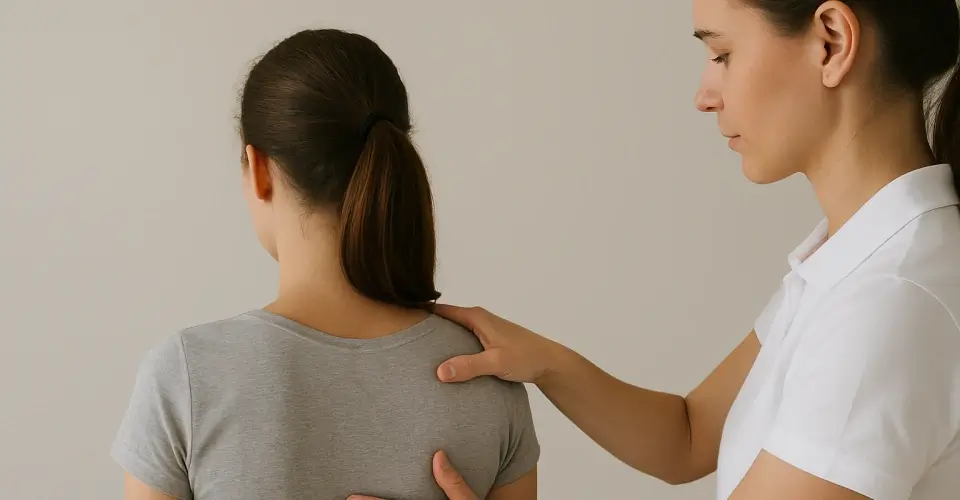
CERVICAL SPINE: THE KEY IS NOT TO GET STUCK.
The key is not to get stuck
Do you remember how our teachers used to scold us with "Sit up straight!", or made us sit with our hands behind our backs? It was uncomfortable, we often complained about it, but for our bodies it was healthy.
The cervical spine is made up of seven vertebrae; the first and second support the head and allow us to rotate it. The cervical spine is naturally curved at an angle of 20 to 40 degrees, which the muscles help us to maintain. It is an extremely mobile and constantly loaded part of the spine. Our physiotherapists are seeing not only adults but also children with cervical spine pain, some as young as ten years old. According to them, the culprits are clear: prolonged and incorrect sitting, hunching over the phone, sitting at the computer and less movement in life. All of this causes, for example, a forward head posture or dominance of the muscles on the front of the neck over those on the back, which affects the posture and curvature of the neck.
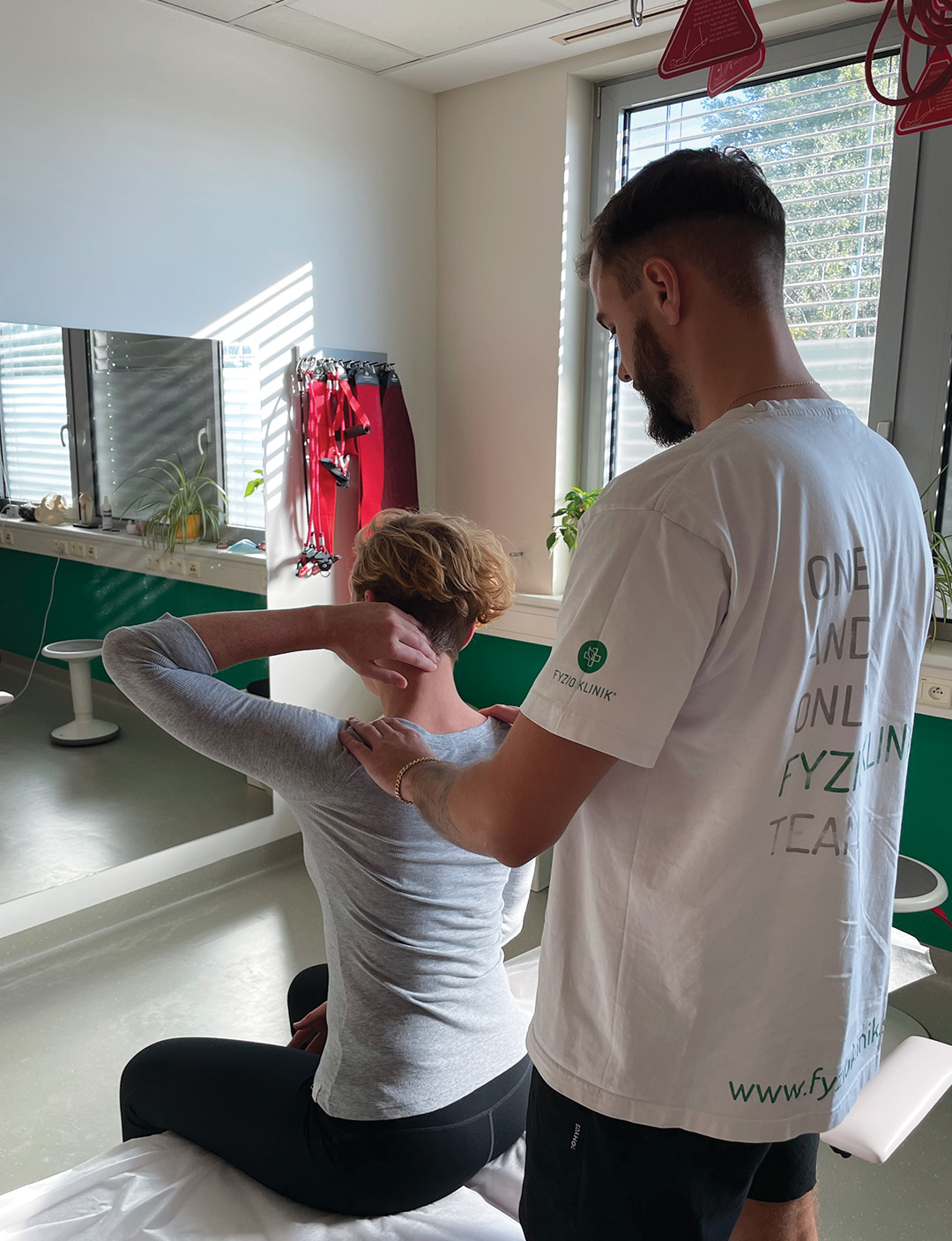
Many patients come to FYZIO KLINIK® with headaches, numbness in the arms, or they feel tension, pulling or tingling in the arms. They know it comes from the cervical spine — their trapezius muscles ache, or they feel stiffness in the area of the shoulder blades. They describe it as having come on suddenly, out of nowhere. And their symptoms have no direct connection to any activity, nor to an injury. They cannot recall a bad sleeping position, nor anything unusual during the day. "The consequences of incorrect sitting, strain or carrying out various activities do not show up immediately," warns our physiotherapist Vladimír Papko. "Our body is very resilient and resolves most problems on its own without us even knowing about it. However, with prolonged incorrect loading, or as we get older, it all catches up with us."

Why does our neck "seize up"?
When the neck "seizes up", it involves stiffening or pinching of a muscle, nerve or blood vessels in the area of the vertebrae. Stiffness in that section most often makes movement in a particular direction impossible. It may irritate the nerve roots — the places where the nerves exit the spinal cord — which causes numbness, but also significant pain. The most important thing is to determine the cause of the pressure of the disc or vertebra on the nerve root, or whether it is a muscle spasm due to a poor sleeping position.
What sort of position?
Most often the one where the head lies right against the shoulder. This causes pressure and stiffening of the muscles in the area between the collarbone, shoulder blade, shoulder and neck, where all the important blood vessels and nerves pass through. If you stay in this position while sleeping for six or more hours, you will wake up feeling broken. Sometimes it takes a while before you can straighten up and loosen up. If this is not possible, it is important to turn to a physiotherapist.
What is the best sleeping position?
The most comfortable is probably the side position. You can use a pillow and position your neck correctly so that it is in a neutral position. Your head must not drop, it should not be tilted towards either shoulder.
Do we need an anatomically shaped pillow?
These pillows are better able to support the cervical spine, but sometimes it is enough to come to the shop, take a small soft, hard, medium-soft and medium-firm pillow, lie down and try out when you feel most comfortable — when your head is completely relaxed and your neck is in a neutral position. You should try a pillow out and not simply buy it by eye or over the internet. Ideally, you should choose it together with the mattress. The mattress provides support for the whole body up to the shoulder, and the pillow is an extension of that support. If you are troubled by long-term problems, it is best to consult a physiotherapist before purchase.
What causes a herniated intervertebral disc?
A typical cause is a pronounced cervical lordosis, that is, an unnatural excessive curvature of the cervical spine of more than forty degrees. With such a great curvature, the disc between the vertebrae is outside its comfort zone. It can press on a nerve, on blood vessels, and can cause stiffening or even spasmodic contraction of the muscles. We most often encounter symptoms such as numbness in the arms and neck and tingling in the fingertips.
How can a headache be related to the cervical spine?
If a headache is directly related to the cervical spine, this is cervicocranial syndrome, i.e. there is irritation of one of the first four spinal nerve roots. This manifests as pain in that section, or in the places where the nerve runs — it can radiate into the arm or lower limbs.
Can the cervical spine also be behind a migraine?
A migraine can also be caused, for example, by an imbalance in the tension of the neck muscles. Often just a single muscle in the neck is responsible, in which a spasm develops from prolonged overload, excessive shortening, lack of movement, or from prolonged incorrect head posture.
Can physiotherapy help in such a case?
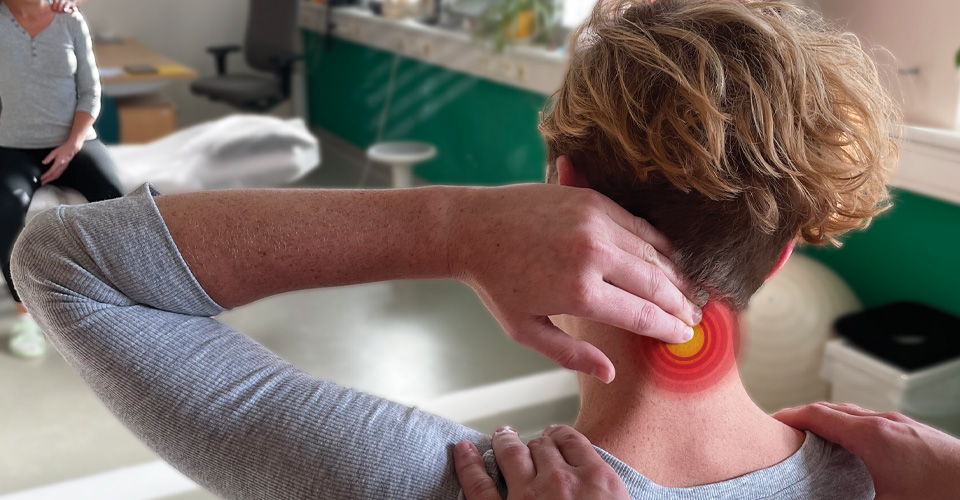
In practice, we influence migraine through the release, or on the contrary the stretching, of certain neck muscles. Let us say that you have pain around the ears, or the pain radiates as far as the temples. I locate the neck muscle on the front of the neck that connects the area around the ear with the collarbone and breastbone, I press on a single point and at that moment you feel relief in the painful zone, even though I am pressing somewhere on the neck.
How is it that just one muscle can be the cause of a headache or even a migraine?
The muscles that usually cause the pain are located on the front or front-side of the neck. The culprits can also be muscles around the collarbone, as well as at the back of the head. This is the place where the hard skull ends and the soft structures begin. I teach patients to massage these areas with their hand or various aids at the onset of a headache. Sometimes the pain miraculously subsides on its own within 10 to 15 seconds. However, it is always important first to establish the correct diagnosis with the help of an MRI, or specific tests.
This article was prepared by senior physiotherapist and chiropractor Vladimír Papko for the magazine RELAX – Sportmedia.