NORDIC WALKING AND ITS BENEFITS
Walking is the most natural and simplest form of movement to keep a person fit. That is precisely why we would like to introduce you to a health-promoting activity suitable for everyone – Nordic Walking at FYZIO KLINIK®.
WHAT IS NORDIC WALKING?
Nordic walking is a form of Nordic-style walking using special walking poles, which you can practise all year round. It is suitable for everyone regardless of age, gender, fitness level or physical condition. It can be practised by older adults, children, pregnant women, people with health limitations, as well as top-level athletes.
It originated in Finland and the first records of it date back to 1930, when cross-country skiers used it as part of their summer training. Because of a lack of snow in certain years, races began to be held without skis, using only poles – these were the very first walking races. Since then, this activity has been studied more thoroughly and it has been discovered that it offers a wealth of benefits.
WHAT ARE THE BENEFITS OF NORDIC WALKING?
Regular walking is recommended by the World Health Organization as the number one activity on its list. The reason is simple: a multitude of health benefits and no contraindications.
Just 35 minutes of brisk walking a day kicks off positive processes in our body on both the physical and mental level. Brisk walking increases blood flow to the brain. However, only with the correct nordic walking technique will you reap all the benefits this activity has to offer.
NORDIC WALKING is beneficial in the following conditions:
- Musculoskeletal disorders as well as post-operative conditions
- Back pain
- Neurological conditions – Parkinson’s disease, Alzheimer’s disease, Multiple sclerosis
- Cardiovascular conditions
- Metabolic conditions – particularly type II diabetes mellitus
- Osteoarthritis, Arthritis and Osteoporosis
- Asthma and respiratory conditions
- Depression
- Learning difficulties and children with special needs
- Oncological conditions
- Lymphatic system disorders
- Digestive disorders
- Overweight and Obesity
IS NORDIC WALKING SUITABLE FOR PEOPLE WITH BACK PAIN?
Yes, it is! This activity is based on physiological principles and the alignment of an active posture. Correct posture in particular is very important in nordic walking, as it focuses on the position of the feet, knees, pelvis, abdomen, shoulders and head.
HOW DO YOU WALK WITH NORDIC WALKING?
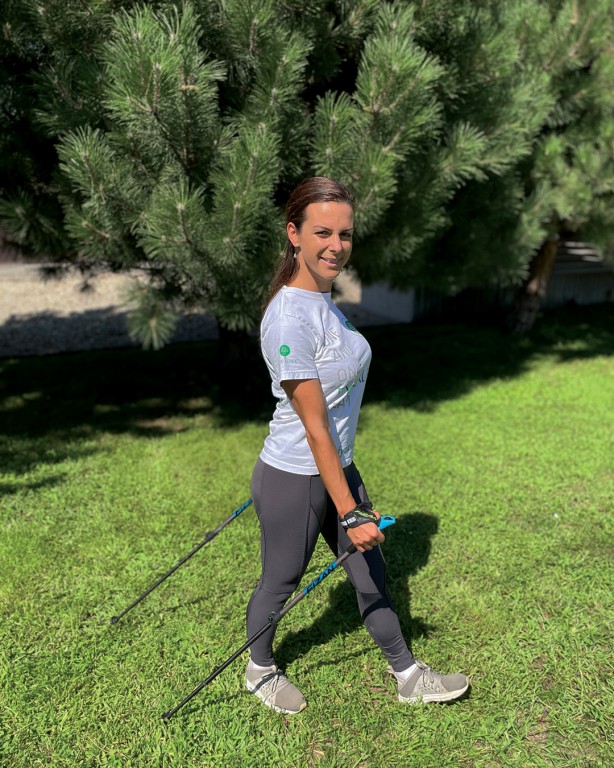
With nordic walking you engage the deep stabilising system, walking in an upright, active posture with engagement of the inner muscles. While walking you do not bend the elbows; instead you maintain a natural arm motion alongside the body with an increased range – 60 percent of the movement should be behind the body and 40 percent in front of it. With a slight rotation of the trunk you engage both the inner and outer back muscles. These become stronger and back pain is eliminated. It is important to maintain the active posture throughout the walk, but at the beginning it is not easy to learn it straight away. It requires training in front of a mirror.
WHAT IS THE DIFFERENCE BETWEEN NORDIC WALKING AND TREKKING?
The difference between trekking and nordic walking lies mainly in posture and the work of the arms. In trekking the poles are used more as support. The arm movement comes only from the elbow and the shoulders remain fixed. The nordic walking technique focuses on a natural arm motion as when walking without poles. In this way the movement originates from the shoulders, the entire arms are engaged, the upper body is activated and the whole body stretches upwards. In trekking, an active posture is not required.
POLES AND EQUIPMENT
Walking poles differ from trekking poles, as they are not used as a support tool. With walking poles and the correct technique you engage up to 90 percent of the muscles in the whole body, which is over 650 muscles. The poles differ from trekking ones in their handle and a comprehensive strap. The handle is ergonomically shaped to stabilise the wrist and prevent dysfunctional twisting and overloading of it. The strap is built into the handle via a special clip system for quick release and is specifically marked for the right and left hand. It wraps around the entire palm, ensures the correct arm technique, fixes the wrist, allows the fingers to open behind the body and supports a quality push-off. The poles are lightweight, made of a carbon-aluminium material, and have an adjustable length for each individual. Likewise, the straps come in various sizes S, M and L to suit individual hand parameters.
To begin with, the instructor will lend you the poles; later you can purchase your own.
The rest of the equipment consists of comfortable sportswear suited to the weather. With nordic walking you wear exclusively low-cut footwear so as to engage as many foot muscles as possible.
HOW TO START WITH NORDIC WALKING?
At FYZIO KLINIK® you can arrange individual training with our certified instructor Lucia Zagyi, who will teach you the correct technique, provide the poles and adjust them for you.
Nordic walking is a workout in which you will have fun and really get a good sweat going. At the same time you will take a step towards your health. And not just one. 😉
WHAT DOES A NORDIC WALKING SESSION LOOK LIKE?
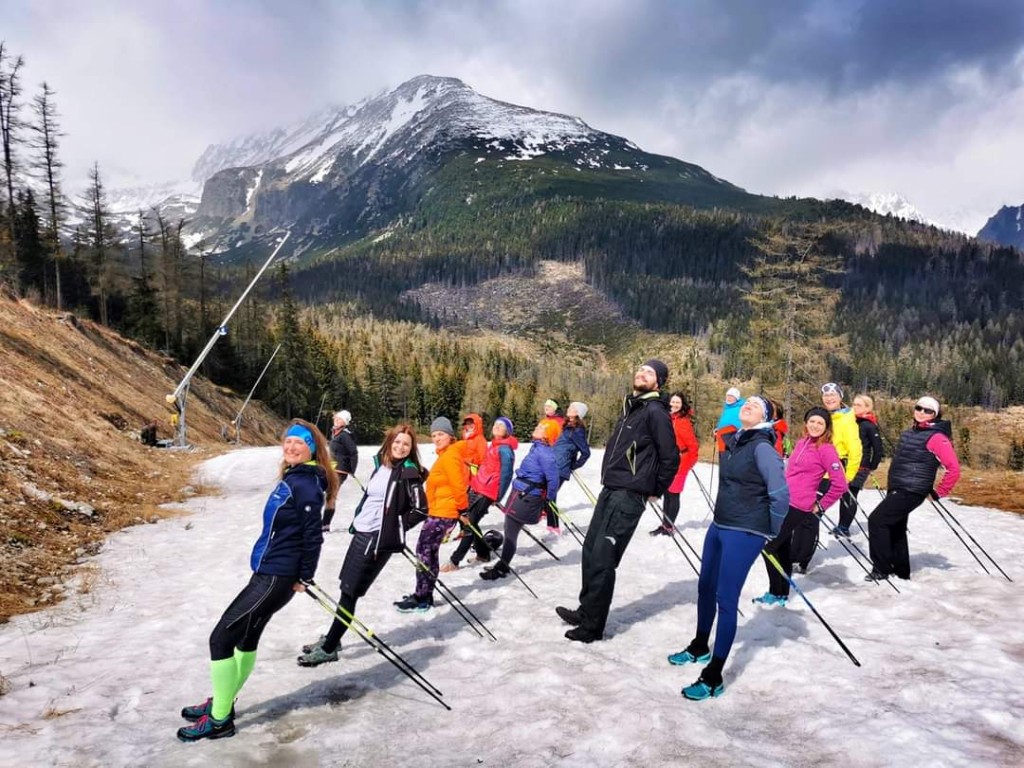
A Nordic walking session at FYZIO KLINIK® lasts 90 minutes.
Like any other sporting activity, walking with poles begins with a warm-up and ends with stretching. During the session, a variety of exercises and games with the poles are used, focused on coordination, technique and strengthening, but above all on having fun.
Movement in the fresh air helps you better cope with everyday stress and unwind from the worries of daily life.
The pace is always adapted to individual requirements, the activity takes place in the heart rate zone of 120 to 140 beats per minute, which is the fat-burning zone.
If you are interested in a Nordic walking session, you can sign up via our app or by phone at reception.
We look forward to seeing you at the next Nordic walking session at FYZIO KLINIK®.
Certified Nordic walking instructor, Mgr. Lucia Zagyi