GOOD POSTURE DOESN'T HURT
What is good posture?
There was a time when it was clear-cut who moved well and who didn't. Today, this kind of "right and wrong" language is no longer used. Every person supposedly has their own movement style and that style is sacrosanct.
It's a bit like handwriting. The style is individual and a matter of choice — everyone has their own slant and letter size — yet spelling is clearly defined and governed by clear rules. The same goes for how our body works. The fact that we bend the arm at the elbow forwards or the knee backwards is dictated by the anatomy of the human body. In this case, the "spelling" is evolutionarily "programmed" into our bones, ligaments, muscles and, not least, the nervous system.
If something hurts, it is worth considering when it hurts, what position you are in, and what comes before the pain. It is essential to realise what is wrong with the way you are currently doing it.
If you can't help yourself on your own, we'll be glad to advise you at FYZIO KLINIK.
Two factors are crucial for changing your own posture:
1. the magnitude of the load
2. the duration
If you fly for 10 hours in an uncomfortable half-seated position on the way to your holiday, you'll probably feel a bit broken, but in all likelihood nothing will happen to you. If, however, you sit slouched in the office for 8 hours a day, you are setting yourself up for problems not only in the lumbar spine, but in the cervical spine as well.
How do we analyse posture during therapy?
At FYZIO KLINIK we draw on several concepts during therapy. In this article we will introduce the SpiralDynamik® concept, in which we work with several poles.
Put simply, if we want to influence the spine, we first need to look at the pelvis, which acts as a kind of base for the spine, and secondly at the head, which sits at the other end of the spine.
The influence of the pelvis on posture. How do we examine pelvic alignment?
The pelvis forms the lower pole of the central coordinating unit — the trunk. It carries the trunk's weight and distributes it to the hip joints. As an elastic "ring", the pelvis provides stability, shock absorption and the balancing of tension. The pelvic bones are mobile thanks to ligamentous connections, which must be both flexible and firm.
Pelvic alignment is key to the condition of the spine.
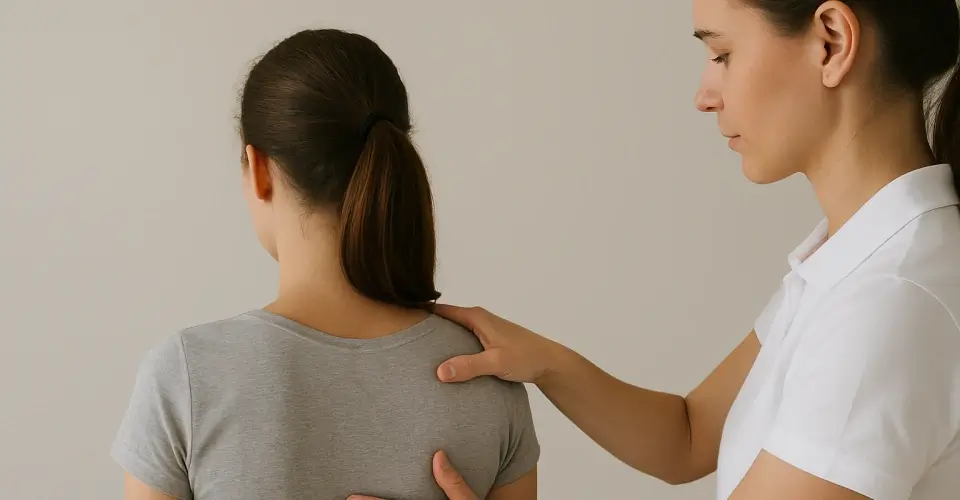
During the examination we observe the client's pelvic alignment from behind and from the side.
We speak of physiologically correct pelvic alignment when the contours of the waist, hips and pelvis are symmetrical and the centre of the pelvis sits on the body's vertical midline.
We also assess the pelvis analytically from the side view, where we note the tilt of the pelvis:
- when the pelvis tilts forwards, we speak of anterior pelvic tilt (anteversion). Imagine your pelvis is a bowl full of water — in an anteverted position the water spills forwards onto the tips of your toes.
- when it tilts backwards, we speak of posterior pelvic tilt (retroversion). In that case the imaginary water spills backwards, onto the heels.
With the pelvis we also take limb length into account.
Finally, we examine the pelvis in motion so that we can assess it functionally.
Correct pelvic alignment is a prerequisite for:
- even side-to-side loading of the spine,
- even loading of the lower limbs and hip joints,
- functional balance of the muscle chains,
- free breathing, as the movement of the diaphragm is balanced from side to side.
What are the ways to improve pelvic alignment?
When the pelvis tilts to one side — for instance, when the right side of the pelvis drops — we work on balancing the muscle tension between the right and left sides.
With anterior and posterior pelvic tilt we work on balancing the muscle tension between the front and back of the body, which means we mainly influence the back muscles, the muscles on the back of the thigh and the abdominal muscles.
The head and good posture. How do we analyse the position of the head?
"To hold one's head high is the mark of being human!" — Giovanni Pico della Mirandola, Italian aristocrat
The head plays a fundamental role in overall body coordination. As the centre of the sensory organs and the organ of balance, it is in constant motion so that we can perceive everything around us.
The position of the head directly influences the cervical spine.
The physiologically correct position of the head is an upright one. We assess it from the front, the back and the side, observing side-to-side symmetries and reference points.
From the side view, in an optimal head position, the ear, shoulder, hip joint, knee and outer ankle should all be in one line, with the head forming a 90-degree angle with the neck.
Faulty head positions are common, such as a forward-jutting head, a head with the chin tucked excessively to the chest, or a head broken back and pressed down onto the neck.
Correct head position is a prerequisite for:
- optimal loading of the cervical spine,
- optimal tension in the muscles of the nape and neck,
- free breathing and clear speech, because the windpipe remains unkinked,
- proper function of the eye muscles, because they are in balance,
- and more.
Let's sum it up. The pelvis and the head define the beginning and end of the spine, which is why their correct alignment is essential for the optimal functioning of your body.
Have a look at the exercise below — a simple way to adjust the tension of the back muscles and improve your posture.
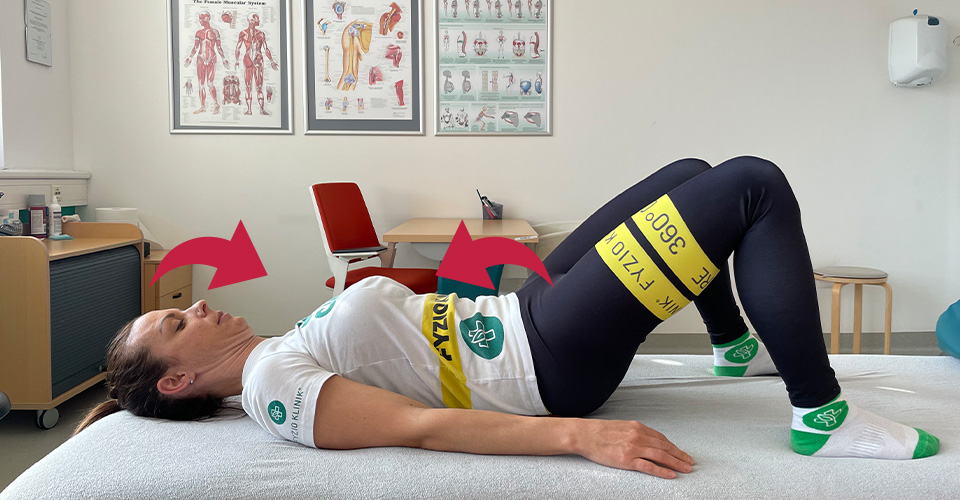
1. Place a ball under the lumbar part of the spine.

2. As you exhale, reach into the distance through the crown of the head while gently drawing the chin towards the breastbone. Pull the tailbone away into the distance towards the heels and at the same time draw the pubic bone up towards the navel, as if the nose and the pubic bone wanted to meet. The range of motion is not large; the spine lengthens pleasantly.
3. As you inhale, guide the head into a gentle backward tilt and at the same time gently lift the lower back away from the mat. The spine shortens.
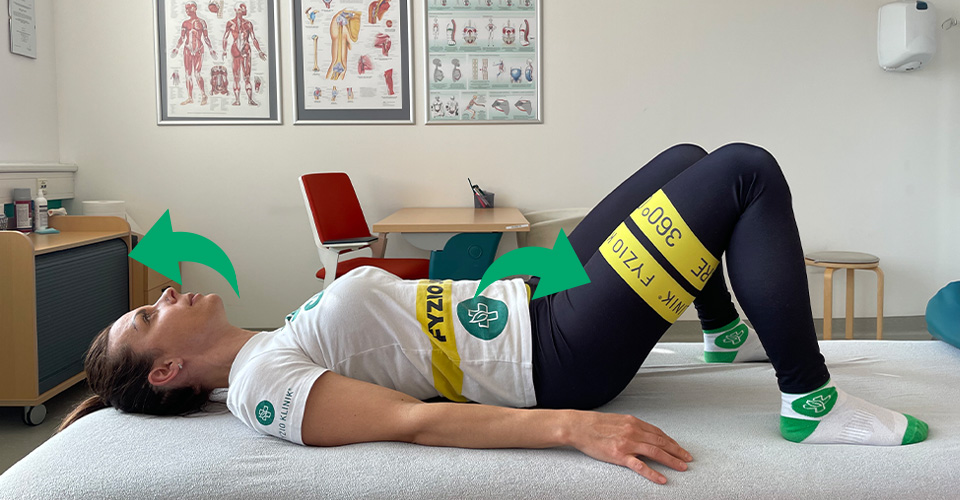
By alternating between lengthening and shortening positions, the tension around the spine is released. While exercising, keep the movement smooth and aim for a three-dimensional execution of the motion.
If you are unsure about your posture, come in for a comprehensive examination at FYZIO KLINIK.
We've got your back 😉
The FYZIO KLINIK team