TEETH GRINDING AND MIGRAINE
Does your jaw ache or are you unable to properly open your stiff mouth?
You may not even be aware of it, but during sleep you clench your jaw, grind your teeth or gnash them. Such a small nocturnal bad habit, which you are likely to be alerted to only by those sharing your bedroom, can seriously diminish your quality of life. Even ordinary activities such as opening and closing your mouth can require considerable effort once they begin to be restricted by pain in the temporomandibular joint or stiffness in this area.
It is important to address teeth clenching as soon as possible. Not only does it lead to transferred and amplified pressure on the muscles and surrounding structures, and consequently on the nerves, which you will certainly feel unpleasantly, but it also leads to changes in the chewing surfaces of the teeth. Over time, the entire geometry of the jaw may change, which will affect the mobility of the temporomandibular joint in relation to the upper jaw and the mandible.
Why do we grind our teeth or clench our jaw?
For many of us, this is caused by a slightly delayed transition of the nervous system, which during relaxation and regeneration switches from the sympathetic to the parasympathetic mode. The whole secret lies in the autonomic nervous system, which governs our body without any conscious influence or intervention. When we begin to yawn, produce saliva or drift into sleep, all of this happens without us being able to influence it through our own will.
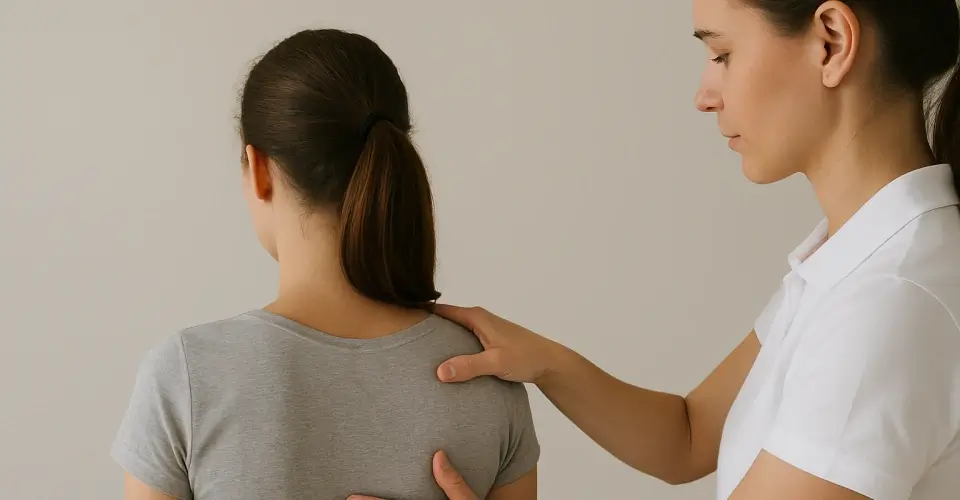
The reason why, during dreaming and experiencing various nocturnal events, we tense the muscles around the jaw or clench our teeth, is a dysregulated autonomic nervous system. With specialised therapies and supplements, experts are able to fine-tune and harmonise this mode. The physiotherapist then releases the muscles in the area of the cervical spine, the back of the head and the diaphragm.
What problems can arise from teeth grinding?
Although clicking and clenching the teeth are among the least demanding bodily movements that we are able to perform even at night, they can give rise to further problems. Such tension also affects the cervical spine or the position of the head, and consequently the entire body during sleep. And the reverse is also true.
Sleeping positions can influence the tension of the biting mechanism of teeth clenching, and thereby the increased pressure that is transferred all the way to the temporomandibular joint and then to the head.
The position in which we fall asleep, or in which we are best able to relax, predetermines the position into which the cervical and thoracic spine settle, and consequently also the head and the junction of the skull and the cervical spine. The cervical spine is most burdened by sleeping on the stomach, which can cause muscle stiffness, pain and incorrect posture.
There is an intense connection between the temporomandibular joint itself and the cervical spine and the first cervical vertebrae, which influences changes in muscle tension. If it is incorrect, it can result in migraines, headaches or throbbing pain in the temple area.
Teeth grinding, any discomfort when chewing or problems with the jaw should not be underestimated, and it is always necessary to seek out a specialist who has experience with the issue and can resolve the problem quickly and effectively.
If you are troubled by such a problem, we can help you at FYZIO KLINIK® as well. Book an appointment for a comprehensive examination with a physiotherapist.
The article was prepared by the co-founder of FYZIO KLINIK®, head physiotherapist, osteopath and chiropractor Tomáš Malárik for the magazine RELAX – Sportmedia.