WHAT TO LOOK OUT FOR IN CHILDREN FROM A MOVEMENT PERSPECTIVE
The transition from nursery school to primary school is a major change for children. It brings not only new educational challenges, but also new movement habits. Are you curious about how children's musculoskeletal system changes and how you can support their healthy development?
Challenges brought by the transition from nursery to primary school
- Physical demands of the school environment
In nursery school, children are encouraged to engage in freer play and movement. They move more, climb and jump. At primary school, on the other hand, they must adapt to longer periods of sitting, more regular breaks and a structured curriculum. This change can affect their muscle tone and posture. - Correct posture
A sedentary lifestyle at school can have an impact on children's posture. It is a good idea to monitor your child's posture when they start school to check whether incorrect movement habits are beginning to appear, such as leaning over the textbook, a poor writing position, an incorrect pen grip and so on. These incorrect habits can lead to problems with the spine and posture. - Ergonomics
It is important to pay attention to the ergonomic setup of the child's working environment, such as the height of the desk and chair, correct posture while sitting and writing, as well as regular breaks for stretching, which help maintain a healthy body position and musculoskeletal system. - Fine motor skills and writing
Less movement and greater demands on fine motor skills. Children are learning to write and draw, which requires precise hand and finger movements. It is important to teach the child the correct way to hold a pencil and pen in order to prevent problems with fine motor skills. - Movement outside school
Encouraging movement outside the school environment, such as organised sports activities, playing in the garden or going for walks, is important for maintaining overall health and the development of the musculoskeletal system.
Sign your child up for our group FYZIO movement sessions. Every Thursday with our physiotherapist Barborka. SIGN UP
What problems can appear when starting school from a physiological point of view?
At school, children put greater strain on their upper limbs because of writing. The arch of the hand often deteriorates, which changes the position of the shoulder blades on the back. The head tips forward and the back becomes rounded. The child has far fewer movement stimuli than they had in nursery school.
When children start school, various physiotherapy issues and postural disorders begin to appear.
- Postural problems: A rounded back (hyperkyphosis) begins to appear, as does excessive arching (hyperlordosis) and scoliosis (sideways curvature of the spine).
- Flat feet: Poor footwear and insufficient sensorimotor stimuli can contribute to the development of flat feet, where the arch of the foot cannot develop properly and becomes flattened. Flat feet can affect posture, gait and overall movement stability. Listen to our podcast about flat feet in children.

- Muscle imbalance: Insufficient movement and one-sided loading can lead to muscle imbalance. Some muscles may lengthen and weaken, while others may become too tight.
- Fine motor problems: When writing, drawing and performing other fine motor activities, children may struggle with concentration, coordination and precision.
- Incorrect pencil and pen grip: An incorrect pencil or pen grip can affect a child's writing ability and skills. A poor writing grip can cause hand fatigue and muscular discomfort.
- Vision problems: Excessive use of electronic devices and screens can affect children's eyesight and contribute to eye problems and poor posture.
- Excessive sitting: Prolonged sitting at school and during homework can lead to muscle weakening, poor posture and spinal problems.
It is important to pay attention to correct posture, the ergonomic setup of the working environment and the encouragement of movement. In this way, we can help children adapt to the new demands and keep their musculoskeletal system healthy and strong.
Prevention of healthy movement habits when starting school
The best way to avoid poor movement habits is to prevent them. We recommend the following:
- Teach your child to sit correctly at the desk
A child may adopt incorrect postural habits while sitting, such as a curved back, leaning downwards, twisting the body or leaning to one side. This can lead to discomfort, fatigue and, gradually, to deterioration in posture. - Teach the correct way to hold a pen/pencil
If a child cannot hold a pencil or pen correctly, it can have a negative impact on their writing ability and skills. An incorrect writing grip can cause hand fatigue and muscular discomfort. - Choose and adjust the school bag correctly
Choose a school bag that is suitable for the child. It should be comfortable to carry and have enough space for books and belongings.
- Teach the correct way to carry the bag
If a child carries the school bag over one shoulder or wears it incorrectly adjusted, it can lead to asymmetric loading of the spine and shoulder muscles. - Do compensatory exercises after school
Which ones? You will find them further on in the article.
- Choose the right footwear
Choose good-quality, comfortable shoes for your child. The right footwear supports a healthy gait and movement. We recommend the orthopaedic footwear Peter Legwood®, which is also suitable for children. You can read more about this footwear HERE.
- Fun and movement / Variety of movement
Encourage movement through fun activities. Exercise should not be seen as a duty, but as an enjoyable way of spending time. Encourage a variety of movement activities. In addition to sitting and writing, the child should have the opportunity to stand, walk, run and exercise. - Role model
Be a positive role model. Healthy movement habits are often a reflection of the behaviour of parents and grandparents.
How to carry a school bag correctly?
Carrying a school bag correctly is important for maintaining a healthy musculoskeletal system and minimising the risk of overloading. Here are a few tips on how a child should carry a school bag:
- The school bag should be worn on the back and not pulled along on wheels behind the child, so that the spine is not loaded one-sidedly.
- The school bag must always be worn on both shoulders. The shoulder straps should always be in the correct position.

- Children grow very quickly, so it is important to check the length of the shoulder straps regularly. The top of the backpack should sit just below the top of the child's shoulders and the bottom should reach just below hip level. The bag should sit properly on the back and must not slip off the shoulders. If the school bag is incorrectly adjusted, it can happen that the child starts to push the chin forward, with shoulders rolled towards the chest, and a hump begins to form on the back and neck.
- The internal organisation of the school bag. When choosing a school bag, also pay attention to the internal space. Your child has to carry many items to school – pencil case, books, exercise books, indoor shoes, snack, drink, and so on. At first glance, it does not seem that school supplies could weigh quite a few kilos. The weight of the backpack should not exceed 15% of the child's body weight. For an average first-grader, that is around 3 kg, but as a rule it is difficult to meet this standard. This weight can only be carried safely if the load is properly distributed. A poorly positioned centre of gravity puts the back into an incorrect position. If the centre of gravity of the load is far from the spine, the lumbar spine bends further forward, into hyperextension. By distributing the contents of the school bag correctly, you can prevent uneven loading of the back muscles. The basic rule is to always place heavy items closest to the back!
- A good-quality backpack: Invest in a good-quality backpack that is ergonomically designed and has sufficient cushioning and padding to ease the pressure on the back.
The child should feel comfortable and should be able to move freely while carrying the school bag. Teach your child the correct way of carrying the bag and pay attention to how they feel, if anything seems uncomfortable or painful to them. Ensuring that the school bag is worn correctly is key to maintaining healthy back movement in children.
Simple compensatory exercises for children after school
When a child starts school, it is important to observe various aspects of your child's body so that you can identify any potential problems with the musculoskeletal system, posture and health in good time. Here are some important factors you should pay attention to. Look out for:
- whether the arches of the feet are collapsing inwards
- whether the knees are tilting into an X position
- whether, when standing, the body twists more to one side
- whether the head tilts to one side
- whether the shoulders are pulled forward, the shoulder blades stick out or the tummy is pushed forward.
When the child comes home from school it is a good idea to:
- Take their shoes off and stimulate the under-stimulated areas of the soles of the feet.

- Exercise in a hanging position. Ideally, hang the child from wall bars or a pull-up bar to lengthen and provide traction to a spine that has been sitting all day. If you do not have a bar at home, head out to a climbing frame in the playground.

- Exercise on a fit-ball to strengthen the core muscles. It is important to strengthen the muscles around the shoulder blades, abdomen and back.

Children should acquire correct movement habits. They will learn this in a playful way at our group FYZIO movement sessions at FYZIO KLINIK®. Sessions for school-aged children every Thursday at 5:00 p.m. SIGN UP

Incorrect and correct sitting in children
If the body is not in the correct position, the hand cannot relax. The most common mistakes include sitting without foot support or with the ankles wrapped around the chair legs.
The child should have their own desk for writing and drawing, with a chair of the correct height. The chair should be neither on wheels nor able to swivel. While writing, it is most comfortable to sit so that the pelvis is on the chair across its full width, leaning slightly forward, with the thighs parallel. The hollows behind the knees must not touch the edge of the chair. The trunk, with the spine kept straight, leans slightly forward towards the desk, but must not rest on it. When completing tasks, the feet should be flat on the floor and the hands placed comfortably on the desk with elbows bent. Hands rested loosely on the desk make it possible to manipulate the exercise book – for right-handers with the top right corner pointing upwards, and for left-handers the opposite way, with the top left corner upwards.
Physiotherapy assessment for children from the age of 3
A physiotherapy assessment for children before they start school is an important step in ensuring their healthy physiological development and preventing various musculoskeletal problems.
What does such an assessment at FYZIO KLINIK® involve?
- Taking a medical history: The physiotherapist begins the assessment by gathering information about the child's state of health, their history of movement problems, injuries and current symptoms.
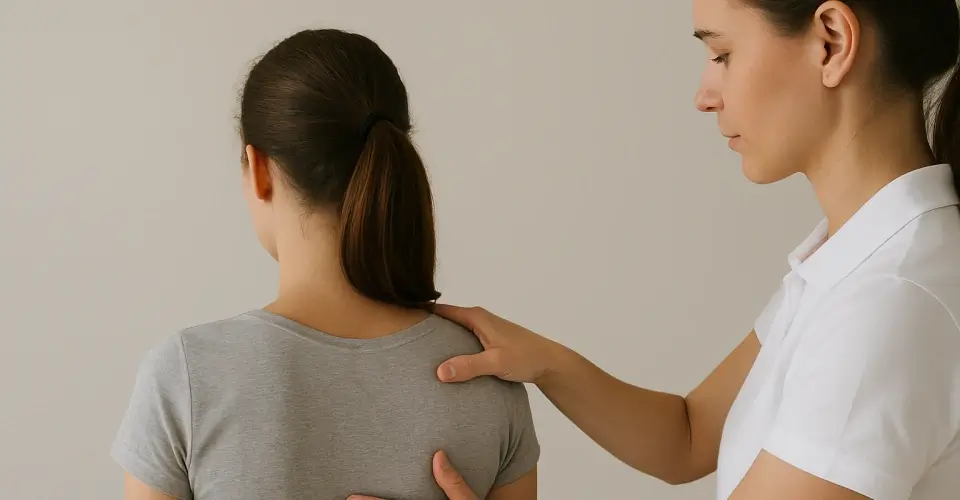
- Visual assessment of posture and body position: The physiotherapist evaluates how the child holds their body when standing, sitting and walking. They check whether there are incorrect movement habits, such as a tilted head, a curved back or other deviations.

- Range of motion and muscular symmetry: They examine the range of motion in the child's various joints and whether there are any restrictions. They also observe muscular symmetry and any imbalances.
- Fine motor skills and coordination: They assess the child's fine motor skills, such as the ability to hold a pencil or pen and to manipulate small objects. They note the coordination of the hands and feet during various activities.
- Functional movement analysis: They carry out movement tests and exercises to assess muscle strength, stability and the functioning of the musculoskeletal system.
- Gait and balance assessment: They observe how the child walks and assess their ability to maintain balance.
- Ergonomic assessment: They evaluate ergonomic aspects such as correct sitting while writing, a suitable desk and chair height, and other factors affecting posture.
- Hydration and eating habits: The physiotherapist may also ask about the child's eating habits and hydration, as nutrition and hydration affect physiological development.
- Developmental analysis: They take into account the child's age and physiological development and compare them with the standards for their age group.
Based on the results of the physiotherapy assessment, we recommend any necessary physiotherapy, an exercise plan, ergonomic improvements or other measures to support the child's healthy musculoskeletal system. The physiotherapist works closely with parents to ensure comprehensive care for the child's movement development.
You can find more about paediatric physiotherapy services at FYZIO KLINIK® HERE.
If you are interested in a comprehensive physiotherapy assessment for your child, book an appointment through our FYZIO KLINIK® app or by phone via reception.
This article was prepared for you by our senior physiotherapist Barbora Grancová, who also specialises in paediatric physiotherapy from the age of 3.🙂

Are you interested in:
- What is the most important thing for children aged 3-6? What is developing at that stage? What is happening with the muscles, tendons and brain?
- What are the most common problems in children aged 3-6?
- What is the cause? When did things go wrong? Could the cause already be present during pregnancy? At birth?
- Is it a good idea for a child to start playing sport early?
- Are we able to spot a talent for sport or another activity at such an early age?
- What do we focus on at FYZIO KLINIK® in terms of prevention for children?
- What should you look out for in your children at home? What can we do for our child in terms of healthy development?
Listen to the FYZIO KLINIK® Podcast with our physiotherapist Barbora Grancová about preventing developmental difficulties in children aged 3 to 6. How can you prevent larger physiological deviations or even diagnoses in your child's life?👇